ラベル Corporatism の投稿を表示しています。 すべての投稿を表示

2011年1月7日金曜日

Breaking!! 米環境保護局EPAが故意に蜜蜂を殺す農薬を認可していた。

やはり蜜蜂が消失した原因は農薬(殺虫剤)だったようです。欧米の大手メディアや日本のアホメディアでは消失の原因が、蜜蜂の病気だとかほざいていたが、コロラドの養蜂家が入手した暴露文書によれば、EPAの科学者自身が蜜蜂に対する毒性が高い農薬(クロチアニジン)であるとし認可を反対していたにもかかわらず、担当官が1993年にバイエルクロップサイエンス社(日本法人もある)による出鱈目な安全試験結果に基づいて故意に認可し続けていたという。

Leaked document: EPA knowingly approved bee-killing pesticide

(NaturalNews) A Colorado beekeeper recently obtained a leaked document revealing that the U.S. Environmental Protection Agency (EPA) knows a popular crop pesticide is killing off honey bees, but has allowed its continued approval anyway. Despite opposition from its own scientists, EPA officials first gave the a-okay to Bayer CropScience's toxic pesticide clothianidin in 1993 based on the company's own flawed safety studies. But now it has been revealed that the EPA knew all along about the dangers of clothianidin and decided to just ignore them.

Learn more: http://www.naturalnews.com/030921_EPA_pesticides.html#ixzz1AGsIY4AO

すでにワイヤードビジョンでもこの問題が取り上げられていた。


ミツバチ集団失踪:疑惑の殺虫剤と米環境保護局 2010年12月16日

流出した文書によると、米環境保護局(EPA)は、自局で働く科学者の懸念をよそに、論争を呼んでいる殺虫剤クロチアニジンの認可を取り消さずにいるようだ。

クロチアニジンは米国で販売されている殺虫剤で、ミツバチが突然大量に失踪する現象「蜂群崩壊症候群」(CCD)との関係があると疑われている。

クロチアニジンは、ドイツの農薬メーカーBayer(バイエル)社が製造しているが、生産国であるドイツのほか、フランス、イタリア、スロベニア等でも販売や使用が禁止されている。

[クロチアニジン(PDF)は、1988年に武田薬品工業が開発したネオニコチノイド系化合物の殺虫剤。日本国内では2001年に農薬登録され、イネ、野菜、茶、花などに幅広く利用されているほか、シロアリ駆除剤等にも利用されている。

ネオニコチノイド系殺虫剤は、昆虫の中枢神経系のニコチン作動性アセチルコリン受容体に作用する。神経受容体の構造が異なるため、人やペットなどの脊椎動物には影響が少ないとされ、利用が広がったが、オランダ、デンマーク等西欧諸国では使用禁止が行なわれている]

クロチアニジンは、植物の組織から吸収された後、花粉や花蜜に放出されて害虫を駆除するように作られているが、これらの諸国は、クロチアニジンがミツバチに対しても危険性があるのではないかと考えている。ミツバチは、一部の植物の繁殖に不可欠な存在だ。
米国のEPAは2003年に、クロチアニジンの米国での使用を認可した。その後、クロチアニジンは米国で広く使われるようになり、昨年は2億6200万ドル相当のクロチアニジンが農場経営者によって購入された。

クロチアニジンは、米国ではテンサイ(砂糖大根)やカノーラ[カノーラ油の原料となるセイヨウアブラナの1変種]、大豆、ヒマワリ、小麦、トウモロ コシ等に使用されているが、特にトウモロコシは、米国でもっとも広く栽培されている、花粉の多い作物で、ミツバチの好物でもある。

今では、ミツバチのコロニーの最大3分の1が消失し、作物の受粉をハチに頼っている米国の農場経営者を悩ませている。これらの農場経営者が栽培する作物の生産高は150億ドルに相当する。
CCDの原因としては、ダニ、バクテリア、菌、生理学的ストレス、養蜂業の疫学的リスクなど、多くの要因が考えられているが、殺虫剤説がもっとも有力であるという意見もあり、今回のEPAの流出文書(PDFファイル)は波紋を投げかけている。

コロラド州の養蜂家Tom Theobald氏が入手し、農薬監視行動ネットワーク(Pesticide Action Network:PAN)が公表したこのメモは、今年11月に、EPAの環境動態・影響部門の科学者らによって作成されたものだ。

同部門の科学者たちは現在、綿とカラシへのクロチアニジンの使用拡大を求めるBayer社の要望書について検討している。このメモには、EPAはク ロチアニジンの初認可を行なった時に、Bayer社による主要な安全性試験を利用したが、この試験が行なわれる前にクロチアニジンが認可されたという経緯 が詳しく書かれている。また、この試験は計画も実施方法もずさんであり、よくても「補足」資料にしかならないという。

EPAのサイトによれば、クロチアニジンのレビューは2012年になるとされている。
[蜂群崩壊症候群」(CCD) では、2006年秋〜現在にかけて、セイヨウミツバチが一夜にして大量に失踪する現象が米国各地で起こった。2006年から2007年に養蜂の25%が消 失したと言われている。西欧諸国やインド、南米、台湾でも報告されており、日本でも2005年ころから社会問題となっている]

Here is English version 

そういえばバイエル社(恐らく農薬メーカーのバイエルクロップサイエンス社はグループ企業)といえばHIVウィルスをワクチンに混ぜて故意に輸出したり、1980年代ですでにアメリカでは認可されていないHIV汚染された旧式血液製剤を日本やアジア、南米諸国に故意に輸出したことで有名になった悪魔会社であるこは日本以外では周知の事であるが…。またこの会社の仕業だったわけですね。さすがヒトラーを支援してたことだけのことはある。懲りずに優生学主義に基づいてどうしても人口削減をしたいようですね。


すでに欧米では抗うつ剤パキシルの危険性が指摘されており、2007年のバージニア銃乱射事件や1999年のコロンバイン高校銃乱射事件でも抗うつ剤が原因ではないかということで抗うつ剤に対する訴訟が頻繁に起きており、最近では賠償責任の判決もでているが、日本ではコイズミ政権以降で認可され、未だに使用され続けていたり、


 インフルエンザのタミフルも同様の薬害問題が日本でも起きている。

そして多くの日本人が有難がって接種していた最近の豚インフルエンザワクチンも深刻な副作用が指摘されていたが、


そして極め付けに子宮頸がんワクチンも不妊化などの深刻な副作用が指摘されているが、


イギリスでは子宮頸がんワクチン(HPVワクチン)接種直後に亡くなった少女もおり、


 さらに子宮頸がんの原因とされるHPVウィルスも大嘘であり、FDAもそれを知っていると指摘する人もいるが、


恐ろしく馬鹿でお人よしな日本人は、製薬メーカーや厚生省が「こんなことをすはずがない」というお上、権威絶対原理主義思想なのでどそれで被害にあっても自己責任と言うしかない…。農薬、薬、ワクチンなどの危険性が世界中で発生しおり、訴訟問題にもなっているにもかかわらず未だに陰謀論だと言い信じない。そういう方は何でも言うがままに飲んだり、打ったりすれば言いと思います。しかしそれで薬害にあっても税金で国民から保障してもらおうと思うなよと思います。繰り返すがここまで危険性が指摘されているのに薬害にあったらそれは自己責任です。

しかし最近の日本の政管民のビジネス動向を見ていると、欧米でこのように詐欺がバレてできなくなったビジネスを日本のお役所やメディア、経団連などを利用して再び行うというグローバルな詐欺ビジネスサイクルがあるようです。ワクチンや薬の詐欺ビジネス以外では、CO2地球温暖化詐欺も欧米では10年前から指摘されており、2009年では「クライメート事件」で決定的な詐欺の証拠が暴かれているにも関わらず、世界で誰も行っておらず、何の意味もない詐欺に基づいた不平等条約である京都議定書を守り続け、意味のない排出権取引を続け中国EUなどにタダで省エネ技術や血税を差し上げたり、毒饅頭の金融詐欺商品を買わされたりと 

世界の詐欺ビジネスのゴミ箱市場 

となっている。

このように政官民の詐欺に遭いそれで破産したり、経済苦になったり、命を落としても自己責任と言わざる負えないが、環境税やワクチン接種が強制されると選択の自由がなくなり有無を言わさず金を騙し取られ、命を落としかねない毒を飲まされるような自体にはならないことを祈るばかりだが…。しかし祈ってもどうにもならない状況にまできているわけですが…。ここまで来ているにもかかわらず未だに気づかない痴呆状態である日本人はこうなる運命でしょうね。


そしてこれかは


「馬鹿は死ななきゃ直らない」

ではなく、

「馬鹿は子孫を残せない」

時代になったようです。


最後にワクチン神話、薬神話について (パート1から6まであります。)


2010年12月17日金曜日

At last, FED disclosed the list that the specific banks got bailout !!

About the case of bailout by FED, Mark Pittman had been going to law against FED to disclose the bank list which got the bailout. But somehow, he died during the trial suddenly... This is just like the movie "The International", I think...

However, at last, FED seems to have disclosed the list.

Meet The 35 Foreign Banks That Got Bailed Out By The Fed (And This Is Just The CPFF Banks)


The 35 companies in question:
UBS
Dexia SA
BNP Paribas
Barclays PLC
Royal Bank of Scotland Group
Commerzbank AG
Danske Bank A/S
ING Groep NV
WestLB
Handelsbanken
Deutsche Post AG
Erste Group Bank AG
NordLB
Free State of Bavaria
KBC
HSH Nordbank AG
Unicredit
HSBC Holdings PLC
DZ Bank AG
Republic of Korea
Rabobank
Sumitomo Mitsui Banking Corporation
Banco Espirito Santo SA
Bank of Nova Scotia
Mizuho Corporate Bank, Ltd.
Syngenta AG
Mitsui & Co Ltd
Bank of Montreal
Caixa Geral de Depósitos
Mitsubishi UFJ Financial Group
Shinhan Financial Group Co Ltd
Mitsubishi Corp
Aegon NV
Royal Bank of Canada
Sumitomo Corp
One may be forgiven to believe that via its FX liquidity swap lines the Fed only bailed out foreign Central Banks, which in turn took the money and funded their own banks. It turns out that is only half the story: we now know the Fed also acted in a secondary bail out capacity, providing over $350 billion in short term funding exclusively to 35 foreign banks, of which the biggest beneficiaries were UBS, Dexia and BNP. Since the funding provided was in the form of ultra-short maturity commercial paper it was essentially equivalent to cash funding. In other words, between October 27, 2008 and August 6, 2009, the Fed spent $350 billion in taxpayer funds to save 35 foreign banks.  read more

 And MBS list that FED purchased

Observations In Progress On The Fed Data Dump (In Which We Learn That Merrill Pledged Up To 77% Of A Fed Loan With Equity Collateral)


This chart shows GS who declared "I'm doing God's work" has ever borrowed 84 times

Goldman Sachs (GS) borrowed 84 times (50 for just the dometic operations) from Fed's dealer facility (PDCF) from Sept. 15 to Nov. 26, 2008 for amounts ranging from USD 100mln to USD 18bln
Bank of America
Bank of America borrowed 118 times from the PDCF from Sept 18 2008 to May 2009, in amount ranging from $375 million to $11 billion. A graphic visualization of BofA borrowings on PDCF

And ECB


Refer the details about bailout at the release document by FED if you wanna know more.
Release Date: December 1, 2010

For immediate release

The Federal Reserve Board on Wednesday posted detailed information on its public website about more than 21,000 individual credit and other transactions conducted to stabilize markets during the recent financial crisis, restore the flow of credit to American families and businesses, and support economic recovery and job creation in the aftermath of the crisis.


They eased the regulation of Glass-Steagall Act by slipping into the government, sold many deceitful financial products like the subprime mortgage and CDS (Weapons of mass destruction),  developed various absurd business in the world and then earned a large amount of money.  

About  the subprime mortgage business model by the wall street and FED


The Crisis of Credit Visualized from Jonathan Jarvis on Vimeo.

About CDS


 Ponzi schem


And about Private bank FED not federal!!


And FED fraud banking system


(ATTENTION!!)
The part proposing the problem in this movie is good. but a solution and idea which this movie suggests to solve the problem are doubtful and may be a trap. It is because the way for creating the sustainable society which is friendly to the earth is various inhuman eco policies exposed together with the global warming fraud in itself and they are decorating the inhuman policies with dreamlike things. It is the same as the way which recommends taking vaccine which has a doubt of various toxic actions... 

So we need to be careful of their solution and I recommend you to watch also this video.


The person who reveals the truth of the problem 
doesn't always present the right solution.


BUT Why is a lot of our tax used for bailout to such financial Mafia which had been swindle? 

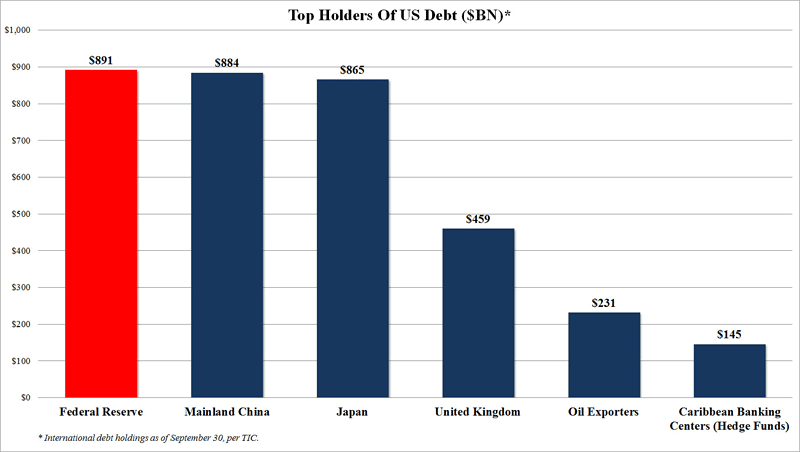
BTW to tell the truth, People swindled by FED is not only American tax payer. The central and private banks in the whole world have cooperated with FED. It is especially China, Japan and U.K.


SOURCE: The Trap of Large Currency Reserves
The above data shows the reason that the Bush administration could reduce housing tax and could attack against Afghanistan and Iraq. A lot of money by Japan, China, Hong Kong, Taiwan, and western Europe supported the Bush administration's mad policies...


 SOURCE:
MAJOR FOREIGN HOLDERS OF TREASURY SECURITIES
 
 
Probably, these data will show only "the short term U.S. Treasury bonds" held by each government of the world.Above all, Japan holds a hell of a lot of various bonds in the US, It is said that Japan holds more bonds in the US when adding the middle term, the long term US Treasury bonds, and commercial SecuritiesGSE- MBS by Fannie Mae and Freddie Mac etc.. held by private financial institutions.


And the total assets that Japan holds abroad amount to $5.5 trillion!! (Net Assets Total is $2.6 trillion ) though there are various views.


Only One small country holds 
the assets for $5.5 trillion by oneself !!!!


But I don't know whether all the assets are composed of the US treasury bonds and American commercial bank's bonds and securities. Probably, bonds and securities in advanced countries (Trade deficit countries), such as Europe and Australia, will be also included in its assets total. Most of the assets for $5.5 trillion  was spent for the trade deficit countries anyway.(So the trade deficit countries are short of money now...)


Japan is substantially one of American colony, so I think that Japan considerably is forced to hold a lot of bonds and securities to support American economy. But Ironically, a lot of the assets will also be one of the causes which make many American jobless people. That is, It is because the US is outsourcing domestic economic activity for about $5.5 trillion overseas and merely keeps creating money out of nothing for its loss...

But most of the money out of nothing is invested and managed only in the financial market and hardly goes to the real market. So the center of the US economy changed into financial business which merely moves much money by dealing with various securities and bonds in the computer. So they recommended Americans to buy than work (Bread and Circus) because various securities and bonds, and property market also prosper if consumption activities prosper. If Americans consume more and more by using many credits cards (leverage consumption), the price of securities, bonds, and real estate price will rise more and then the money in the world will go to the US market.But to begin with, the bubble is brought by creating the money out of nothing and Japanese assets...

The dollar is a "Key currency" which can purchase everything all over the world, so the US can create money out of nothing simply, buy many products from overseas simply and enjoy bread and circus simply. I think that this is the dreamlike world and this means the American dream. So all countries want the dollar naturally.  

However, the dream will end surely someday. And many Americans are awaking from this American dream now like Cob in the movie "Inception". I guess that "Inception" is a message movie to Americans and the real owners of America.  But even if we think that we awoke from a dream and returned to a reality, in fact, that reality may be a new dream (I think the new dream is the world proposed by zeitgeist.).

(BTW I think the Cobb's top(totem) at the last scene of the movie kept spinning though
his children's wear changed. What do you think about this?)

 So while we are alive, we repeat it throughout the whole life and may be not able to arrive at the world to be able to recognize a reality as the reality eternally.

Well, I'll get back the main topic. Securities of the dollar as the key currency are a fraud creating money out of nothing by FED, and the U.S. military power. The ignorance of sheeple in the world will be one of the securities too...These problems are the most troublesome we have to solve.

I think a solution for these troublesome problems may be equal to forcing Americans and the world not to tell a lie, not to abandon overweening greed (That is , to give up the magic dollar which can buy everything by creating out of nothing ), and not to own the gun.

In any case, first of all, not only the US but also the whole world need to learn
Buddhism and Quantum theory and reform people's awareness, i think...
 

2010年10月29日金曜日

Breaking news !! Fed To Disclose Emergency Lending Details By December 1!!

The end of FED is in the final stage?


Well, Will the Americans and the world be able to wake up, escape from the American dream( The world by manufacturing money out of nothing ) by FED like Cobb of the movie "Inception" and come back to the real world?


By the way, Who does implant the idea of "End the FED"( Inception ) in our mind?


"Mark Pittman Wins: Fed To Disclose Emergency Lending Details By December 1"

Submitted by Tyler Durden on 09/29/2010 15:49 -0500

Mark Pittman's last valiant effort to bring some transparency to the most destructive organization in the history of mankind has succeeded. According to testimony to be delivered to the House tomorrow, "under a framework established by the act, the Federal Reserve will, by December 1, provide detailed information regarding individual transactions conducted across a range of credit and liquidity programs over the period from December 1, 2007, to July 20, 2010. This information will include the names of counterparties, the date and dollar value of individual transactions, the terms of repayment, and other relevant information. On an ongoing basis, subject to lags specified by the Congress to protect the efficacy of the programs, the Federal Reserve also will routinely provide information regarding the identities of counterparties, amounts financed or purchased and collateral pledged for transactions under the discount window, open market operations, and emergency lending facilities." Luckily this action by Bernanke will prevent the rioting that would have followed an appeal to the Supreme court, which would have certainly sided with the secretive group of Keynesian priests. If nothing else, the plethora of data will keep the blogosphere preoccupied for days upon days, rummaging through millions of pages of explicit corruption.

Let's see now if December 2nd leads to the end of the world destruction that the Clearing House Association threatened would happen should the Fed disclose these details, as we reported a year ago. To wit:

The Clearing House submits this declaration because the Court's Order threatens to impair the ability of our members to access emergency funds through the New York Fed's Discount Window without suffering the severe competitive harm that public disclosure of their identity will cause.
Our members have accessed the New York Fed's Discount Window with the understanding that the Fed will not publicly disclose information about their borrowing, especially their identity. Industry experience, including very recent and searing experience, has shown that negative rumors about a bank's financial condition - even completely unfounded rumors - have caused competitive harm, including bank runs and failures.
If the names of our member banks who borrow emergency funds are publicly disclosed, the likelihood that a borrowing bank's customers, counterparties and other market participants will draw a negative inference is great. Public speculation that a financial institution is experiencing liquidity shortfalls - which would be a natural inference from having tapped emergency funds - has caused bank customers to withdraw deposits, counterparties to make collateral calls and lenders to accelerate loan repayment or refuse to make new loans. When an institution's customers flee and its credit dries up the institution may suffer severe capital and liquidity strains leaving it in a weakened competitive position.
Or maybe, just maybe, the banks will survive, and all their bullshit will be exposed for the hollow threats it has always been, very much like the end of the world that would have occured had Goldman and AIG been, gasp, allowed to fail.

Below is the relevant section from the Bernanke testimony to be given tomorrow before the Committee on Banking, Housing, and Urban Affairs:

A final element of the Federal Reserve's efforts to implement the Dodd-Frank Act relates to the transparency of our balance sheet and liquidity programs. Well before enactment, we were providing a great deal of relevant information on our website, in statistical releases, and in regular reports to the Congress. Under a framework established by the act, the Federal Reserve will, by December 1, provide detailed information regarding individual transactions conducted across a range of credit and liquidity programs over the period from December 1, 2007, to July 20, 2010. This information will include the names of counterparties, the date and dollar value of individual transactions, the terms of repayment, and other relevant information. On an ongoing basis, subject to lags specified by the Congress to protect the efficacy of the programs, the Federal Reserve also will routinely provide information regarding the identities of counterparties, amounts financed or purchased and collateral pledged for transactions under the discount window, open market operations, and emergency lending facilities.
Full testimony can be found here. We really do hope at least one Congressman will have the guts tomorrow to ask just how it is that the Clearing House Association allowed this act, which will inevitably lead to the collapse of the banking system, to proceed?


And FED seems to have already announced the statement for the reform.


Chairman Ben S. Bernanke "Regulatory Reform Implementation"

Before the Committee on Banking, Housing, and Urban Affairs, U.S. Senate, Washington, D.C.
September 30, 2010

Chairman Dodd, Ranking Member Shelby, and other members of the Committee, thank you for the opportunity to testify about the Federal Reserve's implementation of the Dodd-Frank Wall Street Reform and Consumer Protection Act of 2010 (Dodd-Frank Act).

In the years leading up to the recent financial crisis, the global regulatory framework did not effectively keep pace with the profound changes in the financial system. The Dodd-Frank Act addresses critical gaps and weaknesses of the U.S. regulatory framework, many of which were revealed by the crisis. The Federal Reserve is committed to working with the other financial regulatory agencies to effectively implement and execute the act, while also developing complementary improvements to the financial regulatory framework.

The act gives the Federal Reserve several crucial new responsibilities. These responsibilities include being part of the new Financial Stability Oversight Council, supervision of nonbank financial firms that are designated as systemically important by the council, supervision of thrift holding companies, and the development of enhanced prudential standards for large bank holding companies and systemically important nonbank financial firms designated by the council (including capital, liquidity, stress test, and living will requirements). In addition, the Federal Reserve has or shares important rulemaking authority for implementing the so-called Volcker Rule restrictions on proprietary trading and private fund activities of banking firms, credit risk retention requirements for securitizations, and restrictions on interchange fees for debit cards, among other provisions.

All told, the act requires the Federal Reserve to complete more than 50 rulemakings and sets of formal guidelines, as well as a number of studies and reports, many within a relatively short period. We have also been assigned formal responsibilities to consult and collaborate with other agencies on a substantial number of additional rules, provisions, and studies. Overall, we have identified approximately 250 projects associated with implementing the act. To ensure that we meet our obligations in a timely manner, we are drawing on expertise and resources from across the Federal Reserve System in areas such as banking supervision, economic research, financial markets, consumer protection, payments, and legal analysis. We have created a senior staff position to coordinate our efforts and have developed project-reporting and tracking tools to facilitate management and oversight of all of our implementation responsibilities.

The Federal Reserve is committed to its long-standing practice of ensuring that all its rulemakings be conducted in a fair, open, and transparent manner. Accordingly, we are disclosing on our public website summaries of all communications with members of the public--including banks, trade associations, consumer groups, and academics--regarding matters subject to a proposed or potential future rulemaking under the act.

In addition to our own rulemakings and studies, we have been providing technical and policy advice to the Treasury Department as it works to establish the oversight council and the related Office of Financial Research. We are working with the Treasury to develop the council's organizational documents and structure. We are also assisting the council with the construction of its framework for identifying systemically important nonbank financial firms and financial market utilities, as well as with its required studies on the proprietary trading and private fund activities of banking firms and on financial-sector concentration limits.

Additionally, work is well under way to transfer the Federal Reserve's consumer protection responsibilities specified in the act to the new Bureau of Consumer Financial Protection. A transition team at the Board, headed by Governor Duke, is working closely with Treasury staff responsible for setting up the new agency. We have established the operating accounts and initial funding for the bureau, and we have provided the Treasury detailed information about our programs and staffing in the areas of rulemaking, compliance examinations, policy analysis, complaint handling, and consumer education. We are also providing advice and information about supporting infrastructure that the Bureau will need to carry out its responsibilities, such as human resource systems and information technology.

Well before the enactment of the Dodd-Frank Act, the Federal Reserve was working with other regulatory agencies here and abroad to design and implement a stronger set of prudential requirements for internationally active banking firms. The governing body for the Basel Committee on Banking Supervision reached an agreement a few weeks ago on the major elements of a new financial regulatory architecture, commonly known as Basel III. By increasing the quantity and quality of capital that banking firms must hold and by strengthening liquidity requirements, Basel III aims to constrain bank risk-taking, reduce the incidence and severity of future financial crises, and produce a more resilient financial system. The key elements of this framework are due to be finalized by the end of this year.

In concordance with the letter and the spirit of the act, the Federal Reserve is also continuing its work to strengthen its supervision of the largest, most complex financial firms and to incorporate macroprudential considerations into supervision. As the act recognizes, the Federal Reserve and other financial regulatory agencies must supervise financial institutions and critical infrastructures with an eye toward not only the safety and soundness of each individual firm, but also overall financial stability. Indeed, the crisis demonstrated that a too narrow focus on the safety and soundness of individual firms can result in a failure to detect and thwart emerging threats to financial stability that cut across many firms.

A critical feature of a successful systemic or macroprudential approach to supervision is a multidisciplinary perspective. Our experience in 2009 with the Supervisory Capital Assessment Program (popularly known as the bank stress tests) demonstrated the feasibility and benefits of employing such a perspective.1 The stress tests also showed how much the supervision of systemically important institutions can benefit from simultaneous horizontal evaluations of the practices and portfolios of a number of individual firms and from employment of robust quantitative assessment tools. Building on that experience, we have reoriented our supervision of the largest, most complex banking firms to include a quantitative surveillance mechanism and to make greater use of the broad range of skills of the Federal Reserve staff.

A final element of the Federal Reserve's efforts to implement the Dodd-Frank Act relates to the transparency of our balance sheet and liquidity programs. Well before enactment, we were providing a great deal of relevant information on our website, in statistical releases, and in regular reports to the Congress. Under a framework established by the act, the Federal Reserve will, by December 1, provide detailed information regarding individual transactions conducted across a range of credit and liquidity programs over the period from December 1, 2007, to July 20, 2010. This information will include the names of counterparties, the date and dollar value of individual transactions, the terms of repayment, and other relevant information. On an ongoing basis, subject to lags specified by the Congress to protect the efficacy of the programs, the Federal Reserve also will routinely provide information regarding the identities of counterparties, amounts financed or purchased and collateral pledged for transactions under the discount window, open market operations, and emergency lending facilities.

To conclude, the Dodd-Frank Act is an important step forward for financial regulation in the United States, and it is essential that the act be carried out expeditiously and effectively. The Federal Reserve will work closely with our fellow regulators, the Congress, and the Administration to ensure that the law is implemented in a manner that best protects the stability of our financial system and strengthens the U.S. economy.

1. See Ben S. Bernanke (2010), "The Supervisory Capital Assessment Program--One Year Later," speech delivered at the Federal Reserve Bank of Chicago 46th Annual Conference on Bank Structure and Competition, held in Chicago, Ill., May 6; and Daniel K. Tarullo (2010), "Lessons from the Crisis Stress Tests," speech delivered at the Federal Reserve Board International Research Forum on Monetary Policy, Washington, March 26. Return to text


At last, we may be able to watch this on December 2nd!!