ラベル FED の投稿を表示しています。 すべての投稿を表示

2010年12月17日金曜日

At last, FED disclosed the list that the specific banks got bailout !!

About the case of bailout by FED, Mark Pittman had been going to law against FED to disclose the bank list which got the bailout. But somehow, he died during the trial suddenly... This is just like the movie "The International", I think...

However, at last, FED seems to have disclosed the list.

Meet The 35 Foreign Banks That Got Bailed Out By The Fed (And This Is Just The CPFF Banks)


The 35 companies in question:
UBS
Dexia SA
BNP Paribas
Barclays PLC
Royal Bank of Scotland Group
Commerzbank AG
Danske Bank A/S
ING Groep NV
WestLB
Handelsbanken
Deutsche Post AG
Erste Group Bank AG
NordLB
Free State of Bavaria
KBC
HSH Nordbank AG
Unicredit
HSBC Holdings PLC
DZ Bank AG
Republic of Korea
Rabobank
Sumitomo Mitsui Banking Corporation
Banco Espirito Santo SA
Bank of Nova Scotia
Mizuho Corporate Bank, Ltd.
Syngenta AG
Mitsui & Co Ltd
Bank of Montreal
Caixa Geral de Depósitos
Mitsubishi UFJ Financial Group
Shinhan Financial Group Co Ltd
Mitsubishi Corp
Aegon NV
Royal Bank of Canada
Sumitomo Corp
One may be forgiven to believe that via its FX liquidity swap lines the Fed only bailed out foreign Central Banks, which in turn took the money and funded their own banks. It turns out that is only half the story: we now know the Fed also acted in a secondary bail out capacity, providing over $350 billion in short term funding exclusively to 35 foreign banks, of which the biggest beneficiaries were UBS, Dexia and BNP. Since the funding provided was in the form of ultra-short maturity commercial paper it was essentially equivalent to cash funding. In other words, between October 27, 2008 and August 6, 2009, the Fed spent $350 billion in taxpayer funds to save 35 foreign banks.  read more

 And MBS list that FED purchased

Observations In Progress On The Fed Data Dump (In Which We Learn That Merrill Pledged Up To 77% Of A Fed Loan With Equity Collateral)


This chart shows GS who declared "I'm doing God's work" has ever borrowed 84 times

Goldman Sachs (GS) borrowed 84 times (50 for just the dometic operations) from Fed's dealer facility (PDCF) from Sept. 15 to Nov. 26, 2008 for amounts ranging from USD 100mln to USD 18bln
Bank of America
Bank of America borrowed 118 times from the PDCF from Sept 18 2008 to May 2009, in amount ranging from $375 million to $11 billion. A graphic visualization of BofA borrowings on PDCF

And ECB


Refer the details about bailout at the release document by FED if you wanna know more.
Release Date: December 1, 2010

For immediate release

The Federal Reserve Board on Wednesday posted detailed information on its public website about more than 21,000 individual credit and other transactions conducted to stabilize markets during the recent financial crisis, restore the flow of credit to American families and businesses, and support economic recovery and job creation in the aftermath of the crisis.


They eased the regulation of Glass-Steagall Act by slipping into the government, sold many deceitful financial products like the subprime mortgage and CDS (Weapons of mass destruction),  developed various absurd business in the world and then earned a large amount of money.  

About  the subprime mortgage business model by the wall street and FED


The Crisis of Credit Visualized from Jonathan Jarvis on Vimeo.

About CDS


 Ponzi schem


And about Private bank FED not federal!!


And FED fraud banking system


(ATTENTION!!)
The part proposing the problem in this movie is good. but a solution and idea which this movie suggests to solve the problem are doubtful and may be a trap. It is because the way for creating the sustainable society which is friendly to the earth is various inhuman eco policies exposed together with the global warming fraud in itself and they are decorating the inhuman policies with dreamlike things. It is the same as the way which recommends taking vaccine which has a doubt of various toxic actions... 

So we need to be careful of their solution and I recommend you to watch also this video.


The person who reveals the truth of the problem 
doesn't always present the right solution.


BUT Why is a lot of our tax used for bailout to such financial Mafia which had been swindle? 

BTW to tell the truth, People swindled by FED is not only American tax payer. The central and private banks in the whole world have cooperated with FED. It is especially China, Japan and U.K.
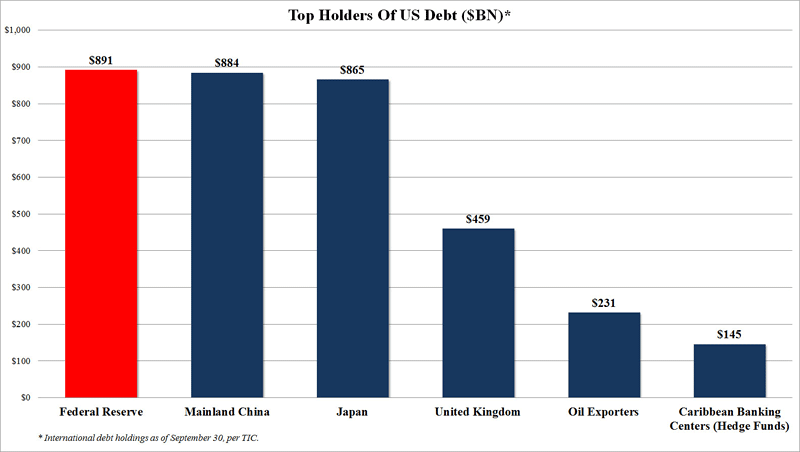


SOURCE: The Trap of Large Currency Reserves
The above data shows the reason that the Bush administration could reduce housing tax and could attack against Afghanistan and Iraq. A lot of money by Japan, China, Hong Kong, Taiwan, and western Europe supported the Bush administration's mad policies...


 SOURCE:
MAJOR FOREIGN HOLDERS OF TREASURY SECURITIES
 
 
Probably, these data will show only "the short term U.S. Treasury bonds" held by each government of the world.Above all, Japan holds a hell of a lot of various bonds in the US, It is said that Japan holds more bonds in the US when adding the middle term, the long term US Treasury bonds, and commercial SecuritiesGSE- MBS by Fannie Mae and Freddie Mac etc.. held by private financial institutions.


And the total assets that Japan holds abroad amount to $5.5 trillion!! (Net Assets Total is $2.6 trillion ) though there are various views.


Only One small country holds 
the assets for $5.5 trillion by oneself !!!!


But I don't know whether all the assets are composed of the US treasury bonds and American commercial bank's bonds and securities. Probably, bonds and securities in advanced countries (Trade deficit countries), such as Europe and Australia, will be also included in its assets total. Most of the assets for $5.5 trillion  was spent for the trade deficit countries anyway.(So the trade deficit countries are short of money now...)


Japan is substantially one of American colony, so I think that Japan considerably is forced to hold a lot of bonds and securities to support American economy. But Ironically, a lot of the assets will also be one of the causes which make many American jobless people. That is, It is because the US is outsourcing domestic economic activity for about $5.5 trillion overseas and merely keeps creating money out of nothing for its loss...

But most of the money out of nothing is invested and managed only in the financial market and hardly goes to the real market. So the center of the US economy changed into financial business which merely moves much money by dealing with various securities and bonds in the computer. So they recommended Americans to buy than work (Bread and Circus) because various securities and bonds, and property market also prosper if consumption activities prosper. If Americans consume more and more by using many credits cards (leverage consumption), the price of securities, bonds, and real estate price will rise more and then the money in the world will go to the US market.But to begin with, the bubble is brought by creating the money out of nothing and Japanese assets...

The dollar is a "Key currency" which can purchase everything all over the world, so the US can create money out of nothing simply, buy many products from overseas simply and enjoy bread and circus simply. I think that this is the dreamlike world and this means the American dream. So all countries want the dollar naturally.  

However, the dream will end surely someday. And many Americans are awaking from this American dream now like Cob in the movie "Inception". I guess that "Inception" is a message movie to Americans and the real owners of America.  But even if we think that we awoke from a dream and returned to a reality, in fact, that reality may be a new dream (I think the new dream is the world proposed by zeitgeist.).

(BTW I think the Cobb's top(totem) at the last scene of the movie kept spinning though
his children's wear changed. What do you think about this?)

 So while we are alive, we repeat it throughout the whole life and may be not able to arrive at the world to be able to recognize a reality as the reality eternally.

Well, I'll get back the main topic. Securities of the dollar as the key currency are a fraud creating money out of nothing by FED, and the U.S. military power. The ignorance of sheeple in the world will be one of the securities too...These problems are the most troublesome we have to solve.

I think a solution for these troublesome problems may be equal to forcing Americans and the world not to tell a lie, not to abandon overweening greed (That is , to give up the magic dollar which can buy everything by creating out of nothing ), and not to own the gun.

In any case, first of all, not only the US but also the whole world need to learn
Buddhism and Quantum theory and reform people's awareness, i think...
 

2010年10月29日金曜日

Breaking news !! Fed To Disclose Emergency Lending Details By December 1!!

The end of FED is in the final stage?


Well, Will the Americans and the world be able to wake up, escape from the American dream( The world by manufacturing money out of nothing ) by FED like Cobb of the movie "Inception" and come back to the real world?


By the way, Who does implant the idea of "End the FED"( Inception ) in our mind?


"Mark Pittman Wins: Fed To Disclose Emergency Lending Details By December 1"

Submitted by Tyler Durden on 09/29/2010 15:49 -0500

Mark Pittman's last valiant effort to bring some transparency to the most destructive organization in the history of mankind has succeeded. According to testimony to be delivered to the House tomorrow, "under a framework established by the act, the Federal Reserve will, by December 1, provide detailed information regarding individual transactions conducted across a range of credit and liquidity programs over the period from December 1, 2007, to July 20, 2010. This information will include the names of counterparties, the date and dollar value of individual transactions, the terms of repayment, and other relevant information. On an ongoing basis, subject to lags specified by the Congress to protect the efficacy of the programs, the Federal Reserve also will routinely provide information regarding the identities of counterparties, amounts financed or purchased and collateral pledged for transactions under the discount window, open market operations, and emergency lending facilities." Luckily this action by Bernanke will prevent the rioting that would have followed an appeal to the Supreme court, which would have certainly sided with the secretive group of Keynesian priests. If nothing else, the plethora of data will keep the blogosphere preoccupied for days upon days, rummaging through millions of pages of explicit corruption.

Let's see now if December 2nd leads to the end of the world destruction that the Clearing House Association threatened would happen should the Fed disclose these details, as we reported a year ago. To wit:

The Clearing House submits this declaration because the Court's Order threatens to impair the ability of our members to access emergency funds through the New York Fed's Discount Window without suffering the severe competitive harm that public disclosure of their identity will cause.
Our members have accessed the New York Fed's Discount Window with the understanding that the Fed will not publicly disclose information about their borrowing, especially their identity. Industry experience, including very recent and searing experience, has shown that negative rumors about a bank's financial condition - even completely unfounded rumors - have caused competitive harm, including bank runs and failures.
If the names of our member banks who borrow emergency funds are publicly disclosed, the likelihood that a borrowing bank's customers, counterparties and other market participants will draw a negative inference is great. Public speculation that a financial institution is experiencing liquidity shortfalls - which would be a natural inference from having tapped emergency funds - has caused bank customers to withdraw deposits, counterparties to make collateral calls and lenders to accelerate loan repayment or refuse to make new loans. When an institution's customers flee and its credit dries up the institution may suffer severe capital and liquidity strains leaving it in a weakened competitive position.
Or maybe, just maybe, the banks will survive, and all their bullshit will be exposed for the hollow threats it has always been, very much like the end of the world that would have occured had Goldman and AIG been, gasp, allowed to fail.

Below is the relevant section from the Bernanke testimony to be given tomorrow before the Committee on Banking, Housing, and Urban Affairs:

A final element of the Federal Reserve's efforts to implement the Dodd-Frank Act relates to the transparency of our balance sheet and liquidity programs. Well before enactment, we were providing a great deal of relevant information on our website, in statistical releases, and in regular reports to the Congress. Under a framework established by the act, the Federal Reserve will, by December 1, provide detailed information regarding individual transactions conducted across a range of credit and liquidity programs over the period from December 1, 2007, to July 20, 2010. This information will include the names of counterparties, the date and dollar value of individual transactions, the terms of repayment, and other relevant information. On an ongoing basis, subject to lags specified by the Congress to protect the efficacy of the programs, the Federal Reserve also will routinely provide information regarding the identities of counterparties, amounts financed or purchased and collateral pledged for transactions under the discount window, open market operations, and emergency lending facilities.
Full testimony can be found here. We really do hope at least one Congressman will have the guts tomorrow to ask just how it is that the Clearing House Association allowed this act, which will inevitably lead to the collapse of the banking system, to proceed?


And FED seems to have already announced the statement for the reform.


Chairman Ben S. Bernanke "Regulatory Reform Implementation"

Before the Committee on Banking, Housing, and Urban Affairs, U.S. Senate, Washington, D.C.
September 30, 2010

Chairman Dodd, Ranking Member Shelby, and other members of the Committee, thank you for the opportunity to testify about the Federal Reserve's implementation of the Dodd-Frank Wall Street Reform and Consumer Protection Act of 2010 (Dodd-Frank Act).

In the years leading up to the recent financial crisis, the global regulatory framework did not effectively keep pace with the profound changes in the financial system. The Dodd-Frank Act addresses critical gaps and weaknesses of the U.S. regulatory framework, many of which were revealed by the crisis. The Federal Reserve is committed to working with the other financial regulatory agencies to effectively implement and execute the act, while also developing complementary improvements to the financial regulatory framework.

The act gives the Federal Reserve several crucial new responsibilities. These responsibilities include being part of the new Financial Stability Oversight Council, supervision of nonbank financial firms that are designated as systemically important by the council, supervision of thrift holding companies, and the development of enhanced prudential standards for large bank holding companies and systemically important nonbank financial firms designated by the council (including capital, liquidity, stress test, and living will requirements). In addition, the Federal Reserve has or shares important rulemaking authority for implementing the so-called Volcker Rule restrictions on proprietary trading and private fund activities of banking firms, credit risk retention requirements for securitizations, and restrictions on interchange fees for debit cards, among other provisions.

All told, the act requires the Federal Reserve to complete more than 50 rulemakings and sets of formal guidelines, as well as a number of studies and reports, many within a relatively short period. We have also been assigned formal responsibilities to consult and collaborate with other agencies on a substantial number of additional rules, provisions, and studies. Overall, we have identified approximately 250 projects associated with implementing the act. To ensure that we meet our obligations in a timely manner, we are drawing on expertise and resources from across the Federal Reserve System in areas such as banking supervision, economic research, financial markets, consumer protection, payments, and legal analysis. We have created a senior staff position to coordinate our efforts and have developed project-reporting and tracking tools to facilitate management and oversight of all of our implementation responsibilities.

The Federal Reserve is committed to its long-standing practice of ensuring that all its rulemakings be conducted in a fair, open, and transparent manner. Accordingly, we are disclosing on our public website summaries of all communications with members of the public--including banks, trade associations, consumer groups, and academics--regarding matters subject to a proposed or potential future rulemaking under the act.

In addition to our own rulemakings and studies, we have been providing technical and policy advice to the Treasury Department as it works to establish the oversight council and the related Office of Financial Research. We are working with the Treasury to develop the council's organizational documents and structure. We are also assisting the council with the construction of its framework for identifying systemically important nonbank financial firms and financial market utilities, as well as with its required studies on the proprietary trading and private fund activities of banking firms and on financial-sector concentration limits.

Additionally, work is well under way to transfer the Federal Reserve's consumer protection responsibilities specified in the act to the new Bureau of Consumer Financial Protection. A transition team at the Board, headed by Governor Duke, is working closely with Treasury staff responsible for setting up the new agency. We have established the operating accounts and initial funding for the bureau, and we have provided the Treasury detailed information about our programs and staffing in the areas of rulemaking, compliance examinations, policy analysis, complaint handling, and consumer education. We are also providing advice and information about supporting infrastructure that the Bureau will need to carry out its responsibilities, such as human resource systems and information technology.

Well before the enactment of the Dodd-Frank Act, the Federal Reserve was working with other regulatory agencies here and abroad to design and implement a stronger set of prudential requirements for internationally active banking firms. The governing body for the Basel Committee on Banking Supervision reached an agreement a few weeks ago on the major elements of a new financial regulatory architecture, commonly known as Basel III. By increasing the quantity and quality of capital that banking firms must hold and by strengthening liquidity requirements, Basel III aims to constrain bank risk-taking, reduce the incidence and severity of future financial crises, and produce a more resilient financial system. The key elements of this framework are due to be finalized by the end of this year.

In concordance with the letter and the spirit of the act, the Federal Reserve is also continuing its work to strengthen its supervision of the largest, most complex financial firms and to incorporate macroprudential considerations into supervision. As the act recognizes, the Federal Reserve and other financial regulatory agencies must supervise financial institutions and critical infrastructures with an eye toward not only the safety and soundness of each individual firm, but also overall financial stability. Indeed, the crisis demonstrated that a too narrow focus on the safety and soundness of individual firms can result in a failure to detect and thwart emerging threats to financial stability that cut across many firms.

A critical feature of a successful systemic or macroprudential approach to supervision is a multidisciplinary perspective. Our experience in 2009 with the Supervisory Capital Assessment Program (popularly known as the bank stress tests) demonstrated the feasibility and benefits of employing such a perspective.1 The stress tests also showed how much the supervision of systemically important institutions can benefit from simultaneous horizontal evaluations of the practices and portfolios of a number of individual firms and from employment of robust quantitative assessment tools. Building on that experience, we have reoriented our supervision of the largest, most complex banking firms to include a quantitative surveillance mechanism and to make greater use of the broad range of skills of the Federal Reserve staff.

A final element of the Federal Reserve's efforts to implement the Dodd-Frank Act relates to the transparency of our balance sheet and liquidity programs. Well before enactment, we were providing a great deal of relevant information on our website, in statistical releases, and in regular reports to the Congress. Under a framework established by the act, the Federal Reserve will, by December 1, provide detailed information regarding individual transactions conducted across a range of credit and liquidity programs over the period from December 1, 2007, to July 20, 2010. This information will include the names of counterparties, the date and dollar value of individual transactions, the terms of repayment, and other relevant information. On an ongoing basis, subject to lags specified by the Congress to protect the efficacy of the programs, the Federal Reserve also will routinely provide information regarding the identities of counterparties, amounts financed or purchased and collateral pledged for transactions under the discount window, open market operations, and emergency lending facilities.

To conclude, the Dodd-Frank Act is an important step forward for financial regulation in the United States, and it is essential that the act be carried out expeditiously and effectively. The Federal Reserve will work closely with our fellow regulators, the Congress, and the Administration to ensure that the law is implemented in a manner that best protects the stability of our financial system and strengthens the U.S. economy.

1. See Ben S. Bernanke (2010), "The Supervisory Capital Assessment Program--One Year Later," speech delivered at the Federal Reserve Bank of Chicago 46th Annual Conference on Bank Structure and Competition, held in Chicago, Ill., May 6; and Daniel K. Tarullo (2010), "Lessons from the Crisis Stress Tests," speech delivered at the Federal Reserve Board International Research Forum on Monetary Policy, Washington, March 26. Return to text


At last, we may be able to watch this on December 2nd!!